Taught or Taut: What’s the Difference? Meaning, Examples and Easy Tricks
You write, “The rope was pulled taught,” and something looks wrong. Or you type, “She taut me how to swim,” and your spell checker stays silent, yet the sentence still feels off. These two words sound exactly the same, and many careful writers stop to wonder which one they need.
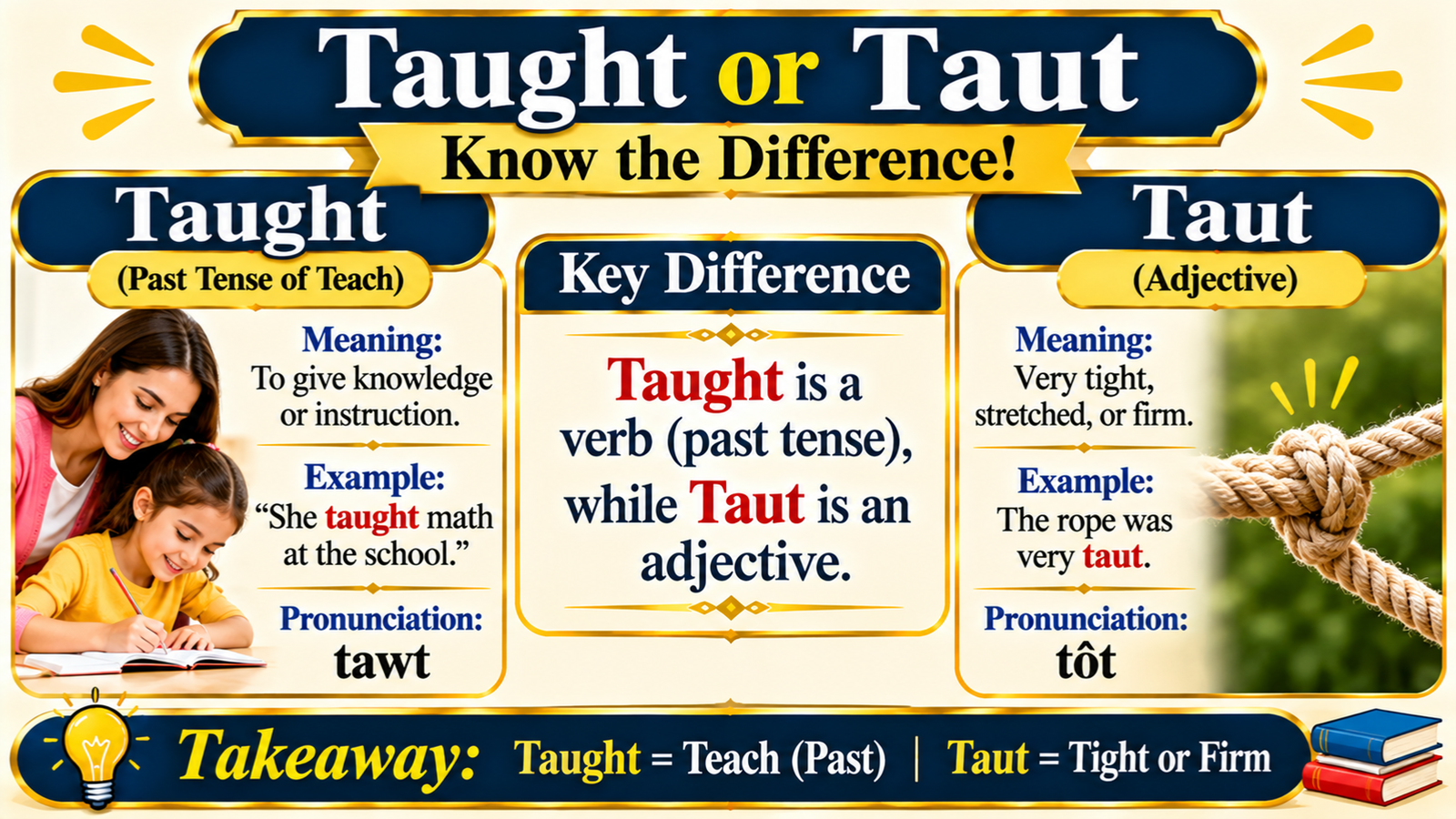
The Taught or Taut question has a clear answer: taught is the past tense of the verb teach, and taut is an adjective that means pulled tight, not slack. In this guide, you will learn the meaning of each word, why they sound identical, where each one comes from, how to use them in sentences, and which mistakes to avoid. You will also get a simple test and memory tricks, so you never have to guess again.
Taught or Taut: Quick Answer
Taught is the past tense and past participle of the verb teach: to give someone knowledge or skill. Taut is an adjective meaning pulled tight, not slack, or tense. The two words sound identical, but they are never interchangeable: use taught for lessons and taut for ropes, muscles, nerves, or a tightly written story.
| Word | Part of speech | Short meaning | Example |
| taught | verb (past tense and past participle of teach) | gave knowledge or instruction | She taught French for twenty years. |
| taut | adjective | pulled tight; tense | The rope was pulled taut. |
Why Are Taught or Taut Confused?
The main reason is sound. Oxford Learner’s Dictionaries gives both words the same pronunciation, /tɔːt/, so you cannot tell by ear which spelling a speaker means. Dictionary notation varies, though: Britannica writes taut as /ˈtɑːt/, which shows how accents differ, but in every accent the two words still sound alike.
Three more things add to the mix-up:
- Both words are short, start with “ta,” and end in “t.”
- Taught has a silent “gh,” and writers often drop it by mistake.
- English has many homophones, so writers often spell what they hear.
The fix is simple: choose the spelling by meaning, not by sound.
What Does “Taught” Mean?
Taught is the past tense and the past participle of teach. To teach is to cause someone to learn something, to give instruction, or to show someone how to do something.
Merriam-Webster lists these forms: teach, teaches, taught, teaching. So “taught” is the form you use for a completed action in the past (“I taught”), and also after have, has, or had (“I have taught”).
Examples of “taught”:
- She taught French for twenty years before she retired.
- My father taught me how to ride a bike.
- He has taught at the university since 2015.
- The course taught students how to write clear reports.
- Life taught her to be patient.
- They were taught to respect their elders.
- I taught myself to play the guitar.
- The accident taught him a hard lesson.
- Who taught you to cook like this?
In Taught or Taut, every “taught” example has something to do with instruction, skill, or learning a lesson. If your sentence is about teaching, the word is taught.
Four Senses of “Teach”
Oxford Learner’s Dictionaries lists four main uses of teach, and taught follows all of them:
- To give lessons. She taught at a primary school before she became a writer.
- To show someone how to do something. My uncle taught me how to sail.
- To change how someone thinks or feels. The trip taught her to be more patient.
- To make someone avoid something because of a bad result (informal). I lost my phone, and that taught me to back up my files.
Notice that the teacher does not have to be a person. An experience, a mistake, or a loss can “teach” you something too, and the past tense is still taught.
Sentence Patterns With “Taught”
Taught appears in four common patterns:
| Pattern | Example |
| taught + person + thing | She taught the children music. |
| taught + thing + to + person | She taught music to the children. |
| taught + person + to + verb | He taught me to drive. |
| taught + person + how to + verb | He taught me how to drive. |
“Taught” as a Past Participle and in Compounds
Taught is both the simple past and the past participle, so it works after have, has, and had, and in passive sentences:
- He has taught here since 2015. (present perfect)
- They had taught us the rules before the match. (past perfect)
- We were taught to respect the rules. (passive)
It also appears in compound adjectives such as self-taught and well-taught: a self-taught artist.
What Does “Taut” Mean?
Taut is an adjective. It describes something that is pulled tight, with no slack or give. It also has several figurative meanings.
Merriam-Webster lists these main senses:
- Tightly drawn, with no give or slack. (a taut rope)
- High-strung or tense. (taut nerves)
- Kept in proper order or condition. (a taut ship)
- Not loose or flabby. (taut skin)
- Marked by economy of structure and detail. (a taut story)
Examples of “taut”:
- The rope was pulled taut and tied to the dock.
- The fisherman smiled when the line grew taut.
- Her face was taut with worry.
- The tent canvas was stretched taut over the poles.
- The room fell silent, and the mood turned taut.
- The film is a taut thriller with no wasted scenes.
- The captain ran a taut ship.
- His muscles were taut after the long run.
- The drummer tightened the skin until it was taut.
In Taught or Taut, every “taut” example describes tightness, tension, or economy. If your sentence is about something tight or tense, the word is taut.
More Dictionary Senses of “Taut”
Oxford Learner’s Dictionaries lists four uses of taut, which match the examples above:
- Pulled firmly tight. Keep the line taut.
- Showing nervousness or tension. Her voice was taut with worry.
- Lean and muscular, with no extra fat. The dancer’s body was lean and taut.
- Precise and free of unnecessary material (writing). a taut thriller
Can “Taut” Be a Verb?
In ordinary use, taut is an adjective. But there is a related verb, tauten, meaning to make something tight or to become tight. Merriam-Webster lists its forms as tauten, tautened, tautening.
- He tautened the rope and tied it off. (to make tight)
- The wire tautened as they pulled. (to become tight)
So you never say “She tauted the rope.” The verb is tauten.
Taught or Taut: The Core Difference Explained
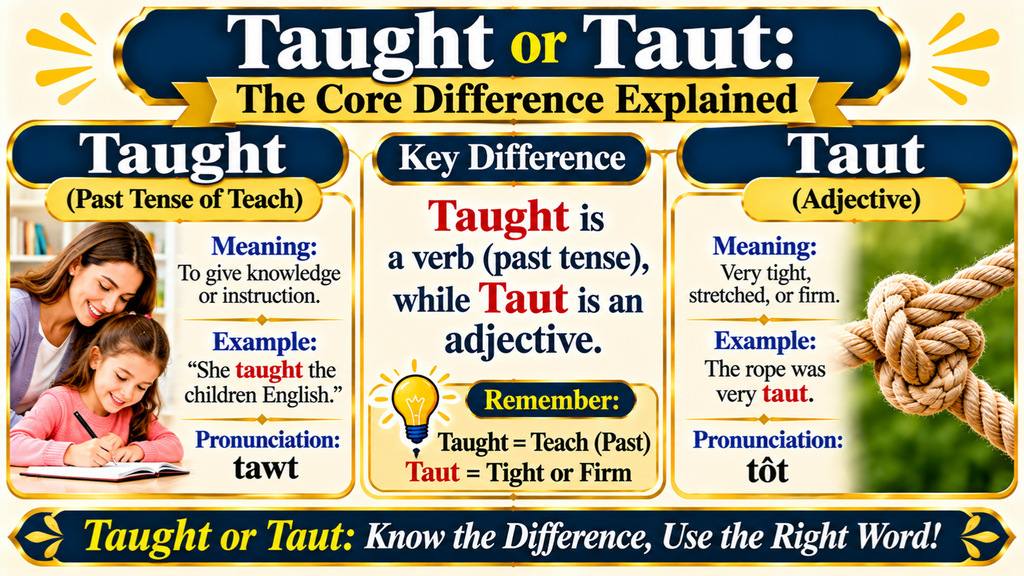
The easiest way to settle Taught or Taut is to ask what job the word does in the sentence.
- Taught is a verb. It describes an action: someone gave instruction.
- Taut is an adjective. It describes a thing: it is tight or tense.
| If you mean… | Use | Example |
| someone gave a lesson in the past | taught | He taught me algebra. |
| something is tight and not loose | taut | The wire was taut. |
| a story or script with no waste | taut | It is a taut drama. |
| nervous or strained feelings | taut | Her nerves were taut. |
A simple substitution test:
- Replace the word with instructed or educated. If the sentence still works, use taught.
- Replace the word with tight or tense. If the sentence still works, use taut.
- “She ___ English.” Instructed fits, so taught.
- “The rope was ___.” Tight fits, so taut.
Taught or Taut Comparison Table
This quick table sums up Taught or Taut:
| Feature | Taught | Taut |
| Part of speech | Verb (past tense and past participle) | Adjective |
| Base word | teach | taut (no verb form needed) |
| Main meaning | gave instruction or knowledge | tight, tense, not slack |
| Pronunciation | /tɔːt/ | /tɔːt/ |
| Spelling clue | has “gh” | no “gh” |
| Used with | people, lessons, skills | ropes, muscles, nerves, stories |
| Related words | teach, teaches, teaching, teacher | tauter, tautest, tautly, tautness, tauten |
| Example | She taught the class. | The rope was taut. |
Pronunciation: Why Taught or Taut Sound the Same
Taught and taut are homophones. Homophones are words that sound the same but have different spellings and meanings. Both are pronounced /tɔːt/, with a long “aw” sound similar to the word caught.
That is the reason the Taught or Taut mix-up is so common. When you speak, no one can hear the difference, so you must rely on spelling and meaning when you write.
| Word | Sound | Rhymes with |
| taught | /tɔːt/ | caught, bought, thought |
| taut | /tɔːt/ | caught, bought, thought |
Accent note: The exact vowel varies by accent. Some American speakers say /tɑt/, closer to “tot.” In any accent, the two words still sound the same as each other.
Spelling clue: Taught has the letters “gh”, like caught, bought, and thought. Taut has no “gh” and is just four letters long.
Other Common Homophones
Taught and taut are one of many homophone pairs in English. Others include:
- there, their, they’re
- to, too, two
- right, write
- flower, flour
- sea, see
With every pair like this, identify the meaning first, then pick the spelling.
Word Origin
The Taught or Taut pair has two different roots, which explains why the meanings differ.
Taught is the past tense of teach. Teach comes from the Old English tǣcan, meaning “to show, point out, or give instruction.” The Old English past tense was tǣhte, which became taught. The root is related to the word token, since both involve the idea of showing or pointing out something.
Taut is older than it looks and has a less certain history. It comes from Middle English, where it was spelled tought. Dictionary sources disagree about the exact origin. Merriam-Webster suggests it may be an alteration of an older word related to tough, while Dictionary.com relates it to tow, in the sense of pulling. Dictionary.com also notes an earlier Middle English form spelled taught, so the two words once overlapped even in spelling.
Both explanations still point to the same idea: taut is about pulling and tightness, and taught is about showing and instruction.
Word Forms of Teach and Taut
Forms of “Teach”
| Form | Word | Example |
| base form | teach | I teach math. |
| third person singular | teaches | She teaches history. |
| past tense | taught | He taught science last year. |
| past participle | taught | They have taught here for years. |
| present participle | teaching | She is teaching a class. |
| noun (person) | teacher | The teacher smiled. |
“Teach” is an irregular verb. It does not add “-ed” for the past tense. The pattern is teach, taught, taught. Never say “teached.”
Forms of “Taut”
| Form | Word | Example |
| adjective | taut | The line is taut. |
| comparative | tauter | The second rope is tauter. |
| superlative | tautest | This is the tautest string on the guitar. |
| adverb | tautly | The cable was stretched tautly. |
| noun | tautness | The tautness of the sail was perfect. |
| verb (less common) | tauten | Tauten the rope before tying it. |
Taught or Taut in Sentences
The best way to master Taught or Taut is to see both words in similar sentences, side by side.
| Sentence with “taught” | Sentence with “taut” |
| The coach taught the team a new play. | The coach’s face was taut with tension. |
| My uncle taught me to fish. | The fishing line was pulled taut. |
| She taught yoga for ten years. | Her muscles stayed taut after the workout. |
| The experience taught him to listen. | The story builds a taut sense of fear. |
| He was taught by a famous painter. | The canvas was stretched taut. |
Same topic, different word:
- The sailor taught the crew to tie knots. (He gave instruction.)
- The sailor pulled the rope taut. (He made it tight.)
Taut in Figurative Use
“Taut” does not only describe ropes. It is a favorite word of writers because it works as a vivid figure of speech.
Physical Tightness
- taut rope, line, wire, or string: The wire was stretched taut.
- taut skin or muscles: His muscles were taut after the race.
- taut sail or canvas: The sail was pulled taut by the wind.
Emotional Tension
- taut nerves: Her nerves were taut with anxiety.
- taut expression or smile: He gave a taut smile and said nothing.
- taut silence: A taut silence filled the room.
Writing and Storytelling
A taut story is one with no wasted words or scenes. Reviewers often use phrases such as “a taut thriller,” “a taut script,” or “taut prose,” meaning that everything is tight and efficient.
Nautical Use
On a ship, a taut ship means a well-run, orderly one. Merriam-Webster lists the sense “kept in proper order or condition,” with “a taut ship” as its example. In everyday life, you can say a manager “runs a taut ship” when the team is disciplined and organized.
Taut vs Tight: Are They the Same?
Taut and tight overlap, but they are not perfect synonyms.
| Situation | Taut | Tight |
| a rope pulled with no slack | ✅ The rope was taut. | ✅ The rope was tight. |
| a nervous voice | ✅ a taut voice | ✅ a tight voice |
| a clothes size | ❌ taut jeans | ✅ tight jeans |
| a schedule | ❌ a taut schedule | ✅ a tight schedule |
| a budget | ❌ a taut budget | ✅ a tight budget |
| a story with no wasted scenes | ✅ a taut story | ✅ a tight story |
Rule of thumb: Taut means “pulled tight, with no slack, or under tension.” Tight is a much broader word. Use taut when something is stretched or strained, and tight for most other meanings.
Taught or Taut in Different Contexts
The context usually settles the Taught or Taut choice at once.
| Context | Word | Example |
| School or university | taught | She taught biology for twenty years. |
| Learning a skill | taught | My uncle taught me how to fish. |
| Learning from experience | taught | The mistake taught him to double-check. |
| Learning on your own | taught | He taught himself to code. |
| Ropes, cables, and wires | taut | The workers pulled the cable taut. |
| Fishing lines | taut | The line went taut. |
| Sails and tents | taut | The sail stayed taut in the wind. |
| Muscles and skin | taut | Her muscles were taut after the race. |
| Feelings and faces | taut | His voice was taut with anger. |
| Stories and films | taut | The film has a taut script. |
Common Collocations
With “taught”:
- taught English / math / history: She taught English abroad.
- taught at a school: He taught at a local high school.
- taught to swim / drive / read: I was taught to swim at age six.
- self-taught: She is a self-taught painter.
- well taught / badly taught: The class was well taught.
- taught a lesson: The loss taught them a lesson.
- taught myself / himself: He taught himself to code.
With “taut”:
- pulled taut / drawn taut / stretched taut: The rope was pulled taut.
- taut rope / line / wire: The line went taut.
- taut muscles / skin: She felt her muscles go taut.
- taut nerves: His nerves were taut.
- taut thriller / script / story: It is a taut thriller.
- run a taut ship: The captain ran a taut ship.
Related Mix-Ups: Taught vs Learned, Taut vs Taunt
Taught vs Learned
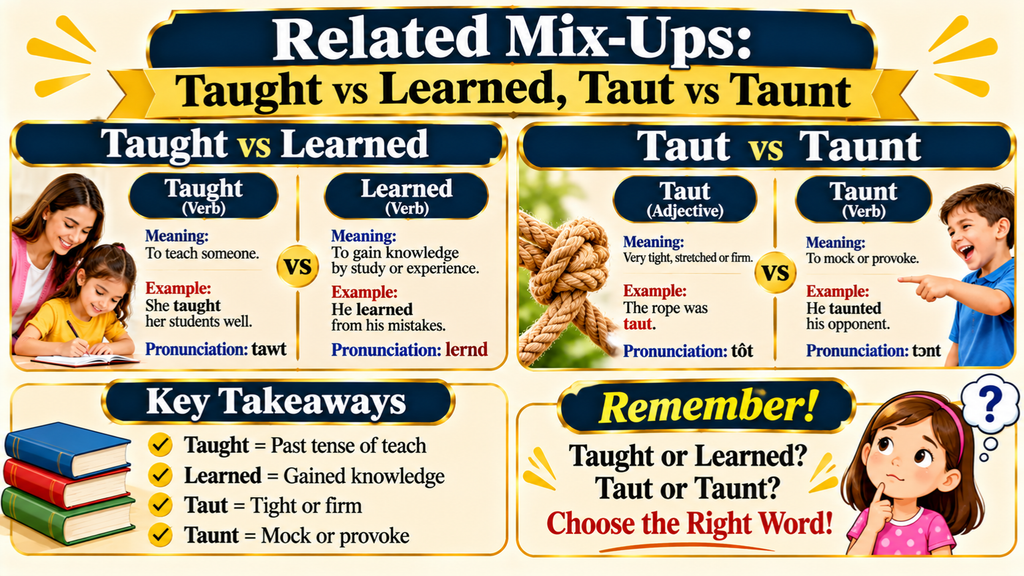
Taught and learned are two sides of the same event. The teacher taught, and the student learned.
- The teacher taught the lesson.
- The students learned the lesson.
Do not say “He learned me to swim.” The correct sentence is “He taught me to swim.”
Taught vs Caught vs Thought
Taught, caught, and thought all share the same ending sound, and they are all past tense forms:
| Base verb | Past tense |
| teach | taught |
| catch | caught |
| think | thought |
| buy | bought |
| bring | brought |
This pattern can help you remember that taught is a verb form.
Taut vs Taunt
Taunt is a different word, and it is not a homophone. As a verb, it means to mock or tease someone with insults. It is pronounced with an “n” sound. Do not write “taunt” when you mean tight.
- The rope was taut. (tight)
- The boys taunted him. (mocked him)
Synonyms and Antonyms
Synonyms for taught:
- instructed
- educated
- trained
- tutored
- coached
- schooled
Synonyms for taut:
- tight
- stretched
- tense
- strained
- rigid
- tightly drawn
Antonyms for taut:
- slack
- loose
- limp
- relaxed
- baggy
Note: “Taught” has no true antonym, but its partner action is learned.
Taught or Taut: A Simple Decision Chart
When you edit a sentence, run through this chart:
| Ask yourself… | Choose |
| Did someone teach, train, or instruct someone? | taught |
| Is the word the past form of teach? | taught |
| Did a lesson or experience change someone? | taught |
| Is something pulled tight, with no slack? | taut |
| Does someone look tense or strained? | taut |
| Are muscles or skin firm and tight? | taut |
| Is a story or script tightly written? | taut |
If the answer involves learning, choose taught. If it involves tightness or tension, choose taut.
Common Mistakes With Taught or Taut
Here are six errors to avoid:
| Incorrect | Correct | Why |
| The rope was pulled taught. | The rope was pulled taut. | Tight needs the adjective taut. |
| She taut me how to swim. | She taught me how to swim. | The past tense of teach is taught. |
| He teached English for ten years. | He taught English for ten years. | “Teach” is irregular, so there is no “teached.” |
| The thriller kept the audience taught until the end. | The thriller kept the audience taut until the end. | Tension is described with taut. |
| I was taut to ride a bike by my father. | I was taught to ride a bike by my father. | Instruction needs the verb taught. |
| The muscles were taunt after the run. | The muscles were taut after the run. | Taunt means to mock, not to tighten. |
Common misspellings to avoid: tought, tuaght, taugt, and taugh. The correct spelling is always taught (verb) or taut (adjective).
Spelling slips like these happen with many pairs. If you enjoy fixing them, see our guides on within vs withing and entail vs intail, and for another past tense that causes spelling doubt, read marveled or marvelled.
A Quick Example: One Wrong Word in a Real Setting
Here is a hypothetical example. Imagine a sailing school hands out a safety sheet that says: “Always keep the mooring line taught.”
A beginner might pause. Was the line taught something? The reader understands the idea, but the error makes the sheet look careless and slightly confusing. The correct instruction is: “Always keep the mooring line taut.” In safety writing and in professional writing, one wrong letter can cost trust.
Memory Tricks and Quick Self-Test
These tricks settle Taught or Taut quickly.
Trick 1: Taught = teach. Taught belongs to the word teach. If a teacher is involved, use the form with “gh”, like caught and bought.
Trick 2: Taut = tight. Taut starts and ends with T, like a rope held tight at both ends. Tight and taut are close in meaning, and both begin with T.
Trick 3: Do the substitution test. Try instructed and tight. The one that fits is the right word.
Quick practice test. Choose taught or taut for each blank.
- My aunt ___ me how to knit.
- Pull the string ___ before you tie the knot.
- The old captain ___ the cadets how to read a chart.
- Her smile was ___ and did not reach her eyes.
- The accident ___ him to wear a helmet.
- The tent poles held the canvas ___.
- Who ___ you to speak so well?
- The editor praised the ___ opening chapter.
- He ___ himself to type without looking.
- A ___ silence followed the announcement.
Answers:
| # | Answer | Why |
| 1 | taught | Someone gave instruction. |
| 2 | taut | The string must be tight. |
| 3 | taught | The captain instructed the cadets. |
| 4 | taut | The smile showed strain. |
| 5 | taught | The accident gave a lesson. |
| 6 | taut | The canvas was stretched tight. |
| 7 | taught | The question is about instruction. |
| 8 | taut | The chapter was tightly written. |
| 9 | taught | He instructed himself. |
| 10 | taut | The silence was tense. |
If you got all ten right, you have mastered Taught or Taut.
Keep Learning: More Word Guides
Other verbs also have confusing forms, such as die, died, dying and dice, diced, dicing, which our guide to die vs dice explains. Short sound-alike words can cause trouble too, so you may enjoy stub vs stud, lag vs log, and clarify vs verify, which separates two verbs that people often swap.
Want more? Browse all of our Vs comparison guides, explore the Spelling category, or read the latest posts on the ClearPenPress blog.
Frequently Asked Questions About Taught or Taut
Is it taught or taut?
Use taught for the past tense of teach (“She taught me”). Use taut for something tight or tense (“The rope is taut”).
Are taught and taut homophones?
Yes. Both are pronounced /tɔːt/. They sound the same but have different spellings and meanings.
What is the past tense of teach?
The past tense and past participle of teach is taught. The forms are teach, teaches, taught, teaching. “Teached” is not a word.
What does taut mean?
Taut means pulled tight with no slack. It can also mean tense or strained, kept in proper order, not loose, or efficient and economical, as in a taut story.
Is it “pulled taut” or “pulled taught”?
It is pulled taut. The adjective taut describes the rope, and taught is a verb about teaching.
What is the comparative of taut?
The comparative is tauter, and the superlative is tautest.
What is a taut ship?
A taut ship is a well-run, orderly ship. People also use “run a taut ship” for a manager who keeps a team disciplined and organized.
Is taunt the same as taut?
No. Taunt means to mock or tease someone. Taut means tight. They are different words and are pronounced differently.
Can taut describe a person?
Yes. You can describe a person’s face, smile, voice, nerves, or muscles as taut, meaning tense or tightly drawn. The word is used for body parts and feelings, not as a general description of a person.
How do I remember which one to use?
Think of teach for taught, and tight for taut. Also, taught has a “gh” like caught, while taut has none.
Is taut a verb?
Not in everyday use. Taut is an adjective. The related verb is tauten, meaning to make tight or become tight (tauten, tautened, tautening).
Can you say “taut muscles” or “taut writing”?
Yes to both. Taut muscles are firm or tense, and taut writing is precise and free of unnecessary material, as in a taut thriller.
Can “taught” describe a lesson from experience?
Yes. A situation can teach someone something, so the past form is still taught: “The mistake taught her to slow down.”
Is taut the same as tight?
Sometimes. In physical contexts, such as a rope, they are close. But tight has many meanings that taut does not share, such as a tight budget or tight jeans.
Final Thoughts
The Taught or Taut choice is easy once you ask what the word is doing. Taught is a verb: the past tense and past participle of teach, used for lessons and instruction. Taut is an adjective: it describes something tight, tense, or economical, from a rope to a nerve to a thriller. Because the two words are homophones, only spelling and meaning tell them apart, so use the substitution test and the memory tricks above.
When you want to say someone gave instruction, write taught. When you want to say something is pulled tight, write taut.
Memory tip: Taught = teach. Taut = tight.
Sources and further reading: Merriam-Webster: taut, Merriam-Webster: teach, Dictionary.com: taut, Etymonline: teach, Grammarly: taught vs taut, and Homophone.com: taught, taut.